Arbitration Clause Thailand: How to Draft It Correctly
Why an Arbitration Clause in Thailand Matters from the Start
An arbitration clause in Thailand is one of the most important provisions in any commercial contract. It determines how disputes will be resolved and whether your business can avoid lengthy and uncertain court litigation.
Many businesses focus on pricing, delivery, and payment terms, but overlook dispute resolution. In practice, however, a poorly drafted arbitration clause can lead to serious legal problems including delays, jurisdictional conflicts, and even unenforceable outcomes.
By properly drafting an arbitration clause in Thailand from the beginning, businesses can ensure that disputes are handled efficiently, professionally, and with enforceable results.
What Is an Arbitration Clause?
An arbitration clause is a contractual provision where parties agree that any disputes arising from the contract will be resolved through arbitration instead of court litigation.
This means that if a dispute occurs, both parties are legally bound to follow the arbitration process agreed in the contract.
For businesses operating in Thailand or entering cross-border agreements, an arbitration clause is a strategic tool to manage legal risks and maintain control over dispute resolution.
Why a Properly Drafted Arbitration Clause Is Critical
A well-drafted arbitration clause in Thailand provides clarity and certainty. Without it, disputes may become more complicated and costly than expected.
Key reasons why it matters:
- Avoids uncertainty about where and how disputes will be resolved
- Prevents delays caused by jurisdictional challenges
- Ensures enforceability of arbitral awards
- Provides a structured and predictable dispute resolution process
In contrast, a vague or incomplete clause can create disputes about the dispute resolution process itself which defeats its purpose entirely.
Key Elements of an Arbitration Clause in Thailand
To be effective, an arbitration clause must clearly define several essential elements:
1. Seat of Arbitration
The “seat” determines the legal framework governing the arbitration. In Thailand, this is typically Bangkok.
2. Governing Law
This specifies which law applies to the contract. It may be Thai law or another agreed legal system. However, if the arbitration proceedings are to take place in Thailand, it is advisable that Thai law be designated as the governing law.
3. Arbitration Institution
Parties should specify the institution that will administer the arbitration, such as:
- Thailand Arbitration Center (THAC)
- Thai Arbitration Institute (TAI)
4. Language of Arbitration
This is especially important for cross-border contracts, where English is commonly used in international agreements. However, if the arbitration proceedings are to take place in Thailand, it is advisable to use the Thai language.
5. Number of Arbitrators
Usually:
- One arbitrator for smaller disputes
- Three arbitrators for complex or high-value disputes
Clearly defining these elements ensures that the arbitration clause in Thailand is practical, enforceable, and aligned with business needs.
Common Mistakes in Arbitration Clauses
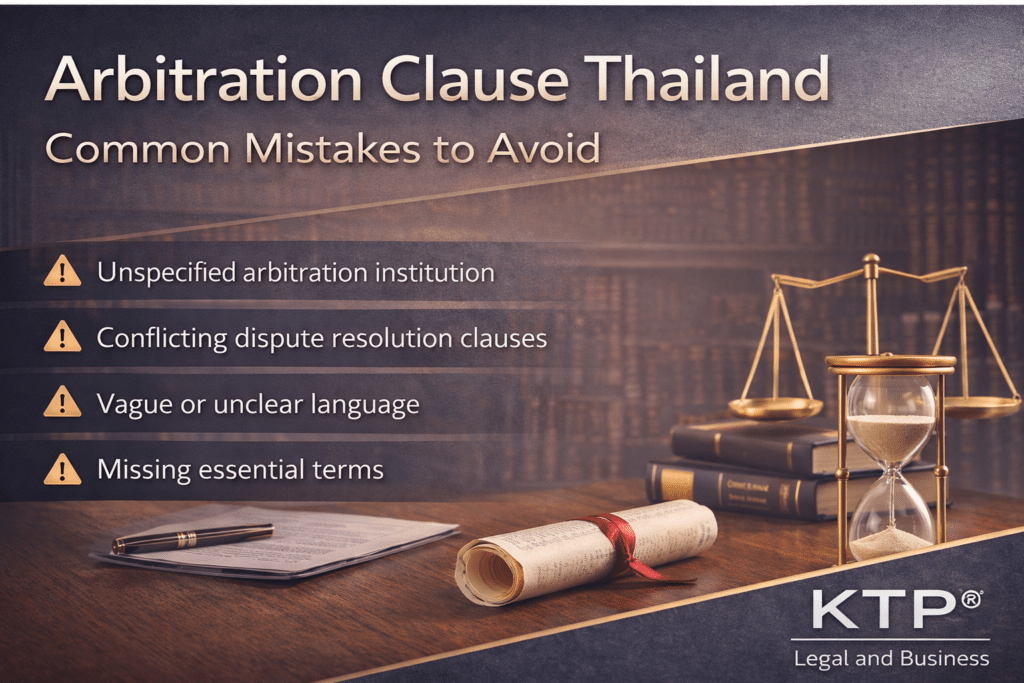
Many arbitration clauses fail because of simple drafting errors. Some of the most common mistakes include:
❌ Not specifying an arbitration institution
This can lead to uncertainty about procedural rules and delays in starting the process.
❌ Conflicting dispute resolution clauses
For example, stating both court jurisdiction and arbitration without clarity.
❌ Unclear or vague language
Ambiguous wording can lead to disputes about whether arbitration even applies.
❌ Missing key elements
Failing to specify seat, governing law, or language can create unnecessary complications.
Avoiding these mistakes is essential to ensure that your arbitration clause in Thailand works as intended.
For a more detailed overview of arbitration and other dispute resolution options, please feel free to explore our alternative dispute resolution services at the following link: Alternative Dispute Resolution
Example of a Simple Arbitration Clause
A basic example of an arbitration clause in Thailand may look like:
“Any dispute arising out of or in connection with this contract shall be referred to and finally resolved by arbitration under the rules of the Thailand Arbitration Center (THAC). The seat of arbitration shall be Bangkok, Thailand. The language of the arbitration shall be Thai.”
This is only a general example. In practice, clauses should be tailored to the specific transaction and business context.
How Arbitration Clauses Affect Enforcement
The effectiveness of an arbitration clause directly impacts the enforceability of the arbitral award.
Thailand recognizes arbitral awards under the Arbitration Act B.E. 2545 (2002), and international enforcement is supported by the New York Convention.
However, if the arbitration clause is unclear or invalid, enforcement may be challenged which can significantly delay recovery.
This is why drafting a clear and legally sound arbitration clause in Thailand is not just a technical step, but a critical business decision.
How Legal Advisors Can Help
Drafting an arbitration clause may seem straightforward, but in reality, it requires legal and strategic consideration.
A qualified lawyer can:
- Tailor the clause to your business model and transaction
- Ensure compliance with Thai law and international standards
- Avoid common drafting mistakes
- Align the clause with enforcement strategy
Having the right legal support from the beginning helps prevent disputes and strengthens your position if disputes arise.
Conclusion
Get Your Arbitration Clause Right from Day One
An arbitration clause in Thailand is more than just a contract provision it is the foundation of your dispute resolution strategy.
A well-drafted clause ensures that disputes are resolved efficiently, fairly, and with enforceable outcomes. On the other hand, a poorly drafted clause can create unnecessary legal risks and complications.
Businesses that take the time to draft their arbitration clauses properly are better prepared to manage disputes and protect their long-term interests.